
Cellenion and SCIENION are now ONE. Transforming precision into progress. Scaling research into real-world impact.

Prototype with Confidence

Access high-end microdispensing technology without overcommitment. The sciFLEXARRAYER S3 is where focused R&D begins: compact, capable, and built for teams who want to prototype with the same precision technology used in advanced manufacturing at low-risk costs. In its Catalyst configuration, it offers full access to reliable picoliter dispensing, ready to support applications like biochips, microarrays, biosensors, or lateral-flow tests. Best of all, it’s built to grow with you: add modules, switch tools, or script your own workflows as your projects evolve. You don’t need to compromise now or re-invest later. Start right, and stay on track.
PRODUCT HIGHLIGHTS
droplet

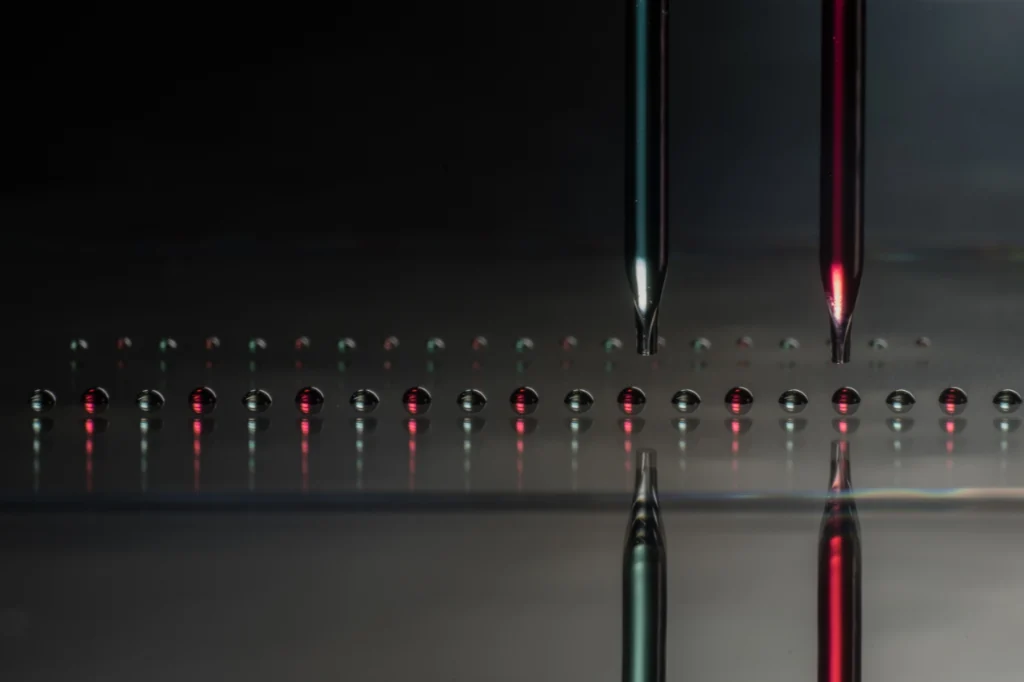
Non-contact liquid dispensing

aim

Ultra-high position precision

drop-ruler

Ultra-high volume accuracy

plant-coin

Cost-efficient configuration

2droplets

All liquids, including high viscosity

efficiency-gauge

Minimal dead volume

BENEFITS
droplets
The S3 supports either picoliter or nanoliter dispensing with high precision. In picoliter mode, it dispenses 10-800 pL per drop with a coefficient of variation (CV) below 2%. In nanoliter mode, it can deliver 50-5000 nL per jet. This dual compatibility enables flexibility for a wide range of R&D applications, from high-density microarrays to low-volume spotting for bioassays. 
KEY FEATURES
1

UP TO 8 DISPENSING CAPILLARIES WITH INDIVIDUAL CONTROLS

2

HIGH PRECISION AND HIGH SPEED XYZ SPINDLE DRIVES

3

HEAD CAMERA FOR POSITION CONTROL AND QC OF TARGETS AFTER SPOTTING

4

UP TO 36 STANDARD MICROSCOPE SLIDES OR 4 MTP PER RUN

5

TARGET DECK, WITH STANDARD OR VACUUM TARGET HOLDER

6

PC CONTROL WITH FLEXIBLE RUN AUTOMATION AND LIVE VISUAL CONTROL OF DROPLET STABILITY

Case Study

PLASMONIC MICROARRAYS FOR NEURODEGENERATIVE RESEARCH WITH SCI FLEXARRAYER S3

The Challenge

Quantifying protein structural changes in drug screening.

EPFL researchers set out to create a labelfree method to study how drugs affect protein aggregation in neurodegenerative diseases. Conventional fluorescence and ThT assays could not reliably detect early aggregation states or mixed structural forms of αsynuclein, limiting insight into drug efficacy. The team needed a platform that combined high throughput screening with nanoscale structural precision.

The Solution

Automated nanoliter spotting for plasmonic IR microarrays

Using the sciFLEXARRAYER S3, droplets of protein drug samples were printed into 48, 96, and 384 well plasmonic sensor chips. Each microwell contained gold nanorod arrays optimized for surface enhanced infrared absorption (SEIRA). The S3’s piezo driven, noncontact dispensing and fiducial control produced highly uniform ~450 pL spots without contamination, vital for infrared precision.
The Outcome

Accelerating label-free biomarker screening in neuroscience.

Published in Advanced Science (2025), the work showed that these plasmonic microarrays quantify protein secondary structures in real-time from as little as 2 nL perwell, with sensitivity down to 100 pg/mL. The arrays offered a new quantitative tool for screening neurodegenerative disease therapeutics with unmatched speed and resolution.

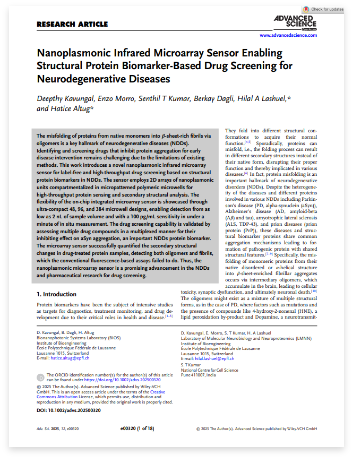
Nanoplasmonic Infrared Microarray Sensor Enabling Structural Protein Biomarker-Based Drug Screening for Neurodegenerative Diseases

Deepthy Kavungal, Enzo Morro, et al, Advanced Science, 2025.

RELATED PRODUCTS