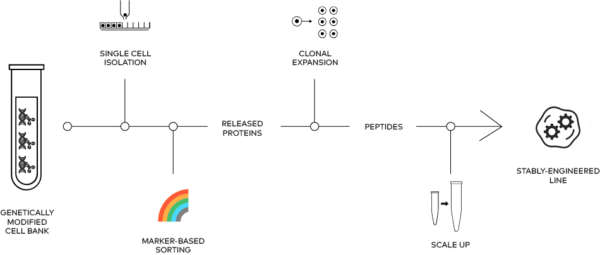
Cell line applications are at the heart of biotechnology and biopharmaceutical research. While Cell Line Development (CLD) focuses on generating stable, scalable, and regulatory-compliant production systems, essential for monoclonal antibody manufacturing, vaccines, and recombinant proteins, Cell Line Engineering (CLE) explores the genetic modification and reprogramming of cells to unlock new functions, model diseases, or produce therapeutic vectors.
Though distinct in scope and timelines, both workflows converge on critical steps such as single-cell cloning, which ensures genetic stability, and reproducibility. Advances in imaging, fluorescence, and automated isolation have transformed these processes, enabling higher confidence and efficiency.

Cell line engineering enables researchers to precisely modify cells to introduce new functions, enhance therapeutic potential, or create advanced disease models. Approaches include gene editing technologies such as CRISPR/Cas9, cell reprogramming through the introduction of new markers, and induced pluripotent stem cell (iPSC) engineering.

Cell line development enables the generation of stable, high-producing monoclonal cell lines for the production of biologics, including monoclonal antibodies, vaccines, recombinant proteins, and viral vectors. The workflow involves multiple stages, including transfection, clone selection, screening, and expansion, where productivity, viability, and compliance must be carefully balanced.