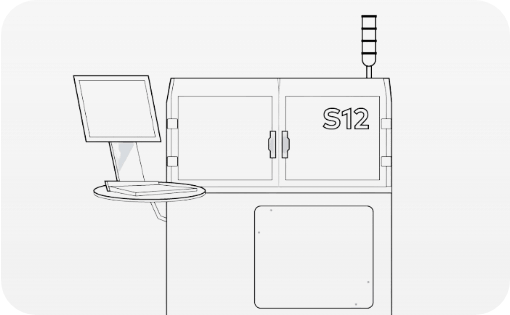
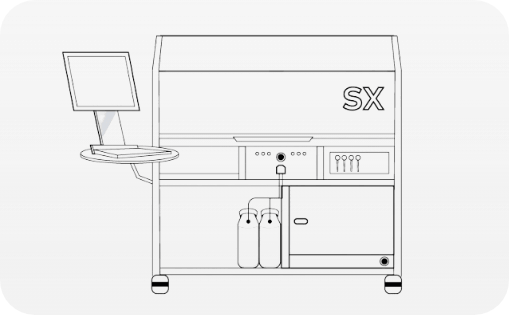
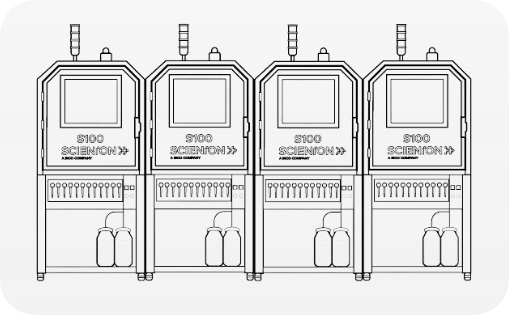
Products - SINGLE CELL DISPENSERS
cellen ONE X1 Neo
cellenONE X1 NEO, the turn-key solution for single cell omics workflows: get the Material, the Methods and the Know-How!
NEO is the optimal tool for the preparation of single cell omics samples, thanks to end-to-end automated workflows and optimized environmental controls allowing on-deck incubations. And because it shares the core technologies of all cellenONE single cell dispensers, it is virtually compatible with any other single cell applications.
Trusted by leading institutions


Single cell isolation

Precision liquid dispensing

On-deck temperature control

Brightfield and/or Fluorescence

Image recording of every isolated cell

End-to-end sample preparation workflows
Benefits
Adjust your instrument to your needs, by adding one or several of our application-dedicated packages: these contain all hardware and software options optimized for your workflows, from cell line development to multiplexed and label free single cell proteomics. Together with this Material & Methods, you receive training from our expert scientists, that transfer their know-how, so you are quickly set to go!
cellenONE NEO introduces advanced environmental controls, including precise temperature and humidity regulation. It ensures optimal conditions for sensitive cell handling, molecular biology reagent safeguarding, and direct incubations of reactions on the printing deck.
Need streamlined single cell proteomics workflow with minimal hands-on time and maximal proteome coverage? The combination of cellenONE NEO and Cellenion proteoCHIP product range provides robust automated method for single cell proteomics sample preparation. Feed the system with your cell sample, let it guide you through your workflow and output your sample ready for LC-MS.
While the NEO introduces powerful new features, it remains, first and foremost, a true cellenONE, offering precise cell and reagent dispensing, up to 100% live single-cell accuracy, customizable sorting parameters, fast startup, flexible multi-sample-to-multi-target workflows, and long-term durability built for sustainable use.
Key Features
UP TO 8 DISPENSING CAPILLARIES WITH INDIVIDUAL CONTROLS
High precision and high speed XYZ spindle drives
Head camera for position control and QC of targets after spotting
UP to 36 STANDARD MICROSCOPE slides or 4 MTP PER RUN
TARGET DECK, WITH STANDARD, or VACCUUM TARGET HOLDER
PC CONTROL WITH FLEXIBE RUN AUTOMATION AND LIVE VISUAL CONTROL OF DROPLET STABILITY
Precision microdispensing applications

Microneedles
Dispensing vaccines, drugs, or diagnostics onto microneedle patches with high precision for minimally invasive delivery platforms.

point-of-care
Develop point-of-care testing devices that provide immediate results, improving patient outcomes through timely diagnosis.

microarray & biosensors
Enabling multiplexed diagnostics with precise spotting of DNA, proteins, or other biomolecules on diverse surfaces.

microfluidics
Filling microhannels, chambers, and lab-on-chip systems with accuracy and repeatability for diagnostics and research workflows.

lateral flow
Automating reagent spotting onto lateral flow assays with consistency and accuracy, from development to large-scale manufacturing

Other applications
Discover flexible solutions for novel formats and challenging substrates across diagnostics, life science, and industrial applications.
Case Study
PLASMONIC MICROARRAYS FOR NEURODEGENERATIVE RESEARCH WITH SCI FLEXARRAYER S3
The Challenge
Quantifying protein structural changes in drug screening.
EPFL researchers set out to create a labelfree method to study how drugs affect protein aggregation in neurodegenerative diseases. Conventional fluorescence and ThT assays could not reliably detect early aggregation states or mixed structural forms of αsynuclein, limiting insight into drug efficacy. The team needed a platform that combined highthroughput screening with nanoscale structural precision.
The Solution
Automated nanoliter spotting for plasmonic IR microarrays
Using the sciFLEXARRAYER S3, droplets of protein drug samples were printed into 48, 96, and 384 well plasmonic sensor chips. Each microwell contained gold nanorod arrays optimized for surface enhanced infrared absorption (SEIRA). The S3’s piezo driven, noncontact dispensing and fiducial control produced highly uniform ~450 pL spots without contamination, vital for infrared precision.
The Outcome
Accelerating label-free biomarker screening in neuroscience.
Published in Advanced Science (2025), the work showed that these
plasmonic microarrays quantify
protein secondary structures in
real-time from as little as 2 nL per
well, with sensitivity down to 100
pg/mL. The arrays offered a new
quantitative tool for screening
neurodegenerative disease therapeutics with unmatched speed and
resolution.
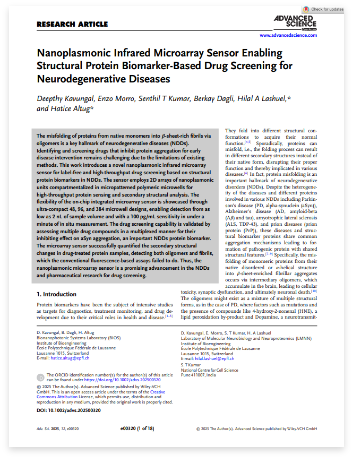
Nanoplasmonic Infrared Microarray Sensor Enabling Structural Protein Biomarker-Based Drug Screening for Neurodegenerative Diseases
Deepthy Kavungal, Enzo Morro, Senthil T Kumar, Berkay Dagli, Hilal A Lashuel, and Hatice Altug.
Advanced Science, 2025